

4. Basics of Balance
Introduction
In seeking to understand how kind and trusting attitudes could have arisen in a fundamentally hostile world, the last chapter saw them to have been actively cultivated, encouraged and reinforced within cooperatively breeding human communities. They facilitated the greater efficiency and increased resources for enabling young children’s brains to grow.
This poses two questions for us. How could these communities themselves have arisen in such a hostile world?, and why has this now changed? This chapter seeks the answer to the first of these. For doing so, it takes us back yet further in time.
Looking for Goodness
Life on Earth is perceived to have begun when four already fairly complex molecules, joined together and stayed together long enough for them to gain access to energy, to disassemble the energy’s carrier molecules, to excrete the waste, and, through cell division, reproduce.
This cell is long gone. Its progeny, however, have lived and carried on living, without interruption, for four billion years. This has been despite snowball Earths, despite asteroid impacts, and despite the many other cataclysmic events that have been thrown at them.
And nor has its progeny remained static. They have assimilated a whole panoply of new abilities of previously non-existent complexity, as if out of nowhere. In doing so, they have produced the vast diversity of species we see in our world today. They have vastly increased the productivity of the world as a whole.
This, it would seem, has not happened by chance. Zoologist V. C. Wynne-Edwards, for instance, writing in the mid-twentieth century, observed that, “When undisturbed by human interference”, life’s natural dynamic has led towards the highest productivity possible within the limits set by the inorganic environment.1
That observation is borne out in the records of European missionaries, explorers and many others, from previous centuries and from all over the world.2,3
Similarly, in Europe, where human influence undoubtedly did “interfere”, comparable perceptions of nature still prevailed, prompting the epithets of Mother Nature and Mother Earth.
And yet, not just our landscapes and food, but our clothes, our pharmaceuticals, our tables, our chairs, our fossil fuels, our concrete and the books and magazines we read, all derive, originally, from this one tiny single cell.
Seen in this context, if goodness at its most basic is taken to be the ability of life to live and to evolve long term, goodness is not something we humans have created. It arises from the resources and principles that enabled life to be formed – and that have continued, subsequently, to support it.
This train of thought takes us, however, only so far. It leads to the observation that those resources and those principles, must, presumably, have been in existence prior to the origins of the first living cell.
This then begs the question, where could they have come from? For this we will need to go back even further. We will need to go back to the material from which the molecules themselves were made. This then takes us all the way back to the origins of the universe itself.
Groundings for Goodness
It is widely accepted within science, that the only resource existing at the universe’s beginning, was energy, an astoundingly huge amount concentrated in a small space. All physical matter in the universe, in our own solar system and in all life on Earth, including ourselves and our creations, were created from it. That energy formed us and it continues to flow through us.
It follows that the rules governing that energy’s behaviour, both then and now, will continue to affect us. They will provide the principles for our continuing existence. They are not remote curiosities from a far distant past. They are essential requirements for understanding how we should be living in our lives today.
The energy existing when the universe began, had three basic properties, intense concentratedness, a very strong tendency to spread out as efficiently as it could to become ever more diffuse, and a clumpy nature. This chapter looks at the effects of the first two of these, and in particular, at the effects of energy’s spreading.
For this purpose two concepts of physics need explaining. The first is entropy [Def]. Entropy is the amount of diffuseness created in energy as it spreads. This, it is accepted, seems strange. Instead of measuring the concentratedness destroyed, it measures the diffuseness created. Confusing as this can seem from a common perspective, it, to physicists, makes sense.
There is, however, a bigger problem. It is that entropy production, commonly termed entropic decay [Def], is widely perceived to be unrelentingly destructive. Ending, it is said, in the “heat death” of the universe, it is viewed as antagonistic to life.
This is not the case. The reason is that, as energy spreads, it has two outcomes. One is entropy production. The other is the capacity generated by energy’s spreading “to do useful work”. This potential is referred to as exergy [Def].
Human factories, as one example, are powered by the work that exergy provides. It is used to convert raw materials into useful products.
At a molecular level, this is achieved by investing some of energy’s exergy in the creation of molecular bonds. They, in pulling and holding atoms and molecules together, enable the building of new physical structures and the products the factory wants. The entropy that results is emitted as waste heat.
Similar processes, although on a vastly greater scale, occurred at the creation of the universe. During the Big Bang the rate of energy’s spreading was phenomenally huge, and so too, therefore, would have been the amount of useful work resulting.
It converted concentrated energy into mass (in accordance with Einstein’s famous equation E=mc2), producing all the particles from which atoms are made, and the bonds to hold them together.
These particles and bonds have, in turn, created the universe’s physical structure and all life within it. We, that is, owe our existence to entropic decay.
That said the fixing of exergetic energy within particles and bonds rather than spreading it, seems to offend against the universal tendency for energy to spread out, as efficiently as it can, to become ever more diffuse. So how can this be?
The bit that is missing in this scenario is that, in storing high exergy energy in structure, far more exergy is expended in generating the useful work needed to do this, than actually gets stored. On balance, therefore, these processes result in high exergy loss and high entropy production.
Once created, maintaining such structures require further regular inputs of exergetic energy, that further compound these effects.
Complex structures, that is, greatly increase the rate of entropy production overall, our living world being a practical example.
Making Sense
For seeking to understand these processes it is useful to identify the two counteracting pressures at work. One is entropic decay. It pulls energy’s concentratedness apart. The other is exergy. It pulls atoms and molecules together.
Working together they enable life to live and thrive, they enable life’s productivity to progressively increase, and, in consuming energy’s exergy, they promote entropy production.
There is, at the same time, a caveat. This was recognised by Wynne-Edwards, above, when he said, “life’s natural dynamic has led towards the highest productivity possible within the limits set by the inorganic environment”. The environment sets the limits on life’s productivity and, by extension, on its entropy production.
The same occurred it can be recognised at the time of the Big Bang. Energy was not highly concentrated one moment and entirely diffuse the next. The rate at which energy has spread, and continues to spread, has been constrained.
With regard to Earth life systems, the process of limit-setting, which is represented mathematically by the logistic curve, has become, over time, highly sophisticated.
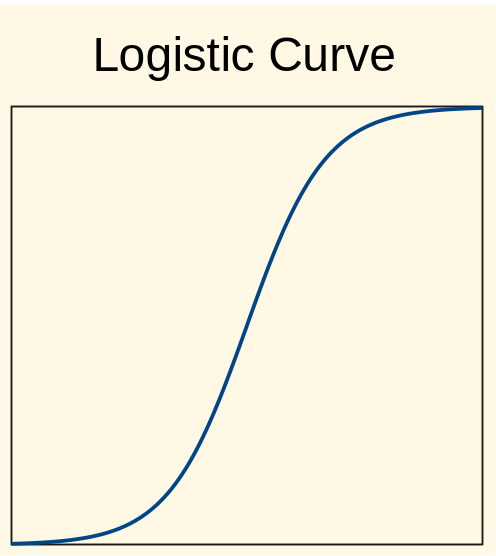
The curve identifies slow, and yet accelerating, initial growth, a subsequent transition to rapid linear growth, and then a gradual levelling off as the capacity of the environment approaches.
At the highest level, the pressures pulling together and pulling apart are perceived to exist in a constructive balance that enables high productivity to continue.
Growth, the vertical axis on this curve, is perceived to apply to the population growth of individual species, to the productivity and entropy production of ecosystems, and to the productivity and entropy production of Earth systems as a whole.4,5
The Goodness Principle
These observations have led scientists to formulate a key scientific principle to describe them. Termed the Maximum Entropy Production Principle or MEPP [Def], it identifies a universal tendency for open systems, that exist far from thermodynamic equilibrium, to increase their rate of entropy production, that is their rate of energy spreading, up to the maximum rate the environment can sustain.6,7
The principle is wholistic. As observed with the investment of exergetic energy in physical matter, molecular bonds and complex structures, high entropy production is actively constrained at the local level. Effectively, nature sacrifices entropy production at this level if this will increase it at higher levels. The principle applies, that is, to whole systems, not to their individual parts.
That said, for general human consumption, the principle phrased as above is not helpful. In amplifying the pulling apart aspect of entropy when this term is widely misconceived, within this book that is seeking better understanding, it seems likely to aggravate misunderstanding rather than reduce it. Here, therefore, an alternative phraseology is used.
It builds on the observation that, in the complex environments in which we are living, high productivity and high levels of entropy production are, for all practical purposes, equivalent. This leads to the alternative phrasing, being the Maximum Sustainable Productivity Principle, or MSPP [Def].
It observes the universal tendency for open systems that exist far from thermodynamic equilibrium to increase their productivity up to the maximum the environment is able to sustain.
Somewhat unexpectedly, this gives the principle a moral tone. In encouraging productivity and growth within sustainable limits, it is something most people would think of as good. Also, and significantly, it would not have been hostile to the emergence of cooperatively breeding human communities.
It is, at the same time, merely a principle, a statement of seeming intent. It has no coherent motivating force behind it, and no coherent process with which it can be achieved. Without these it is impotent. That said, the observations of Wynne-Edwards, those of previous missionaries and explorers, and the existence of cooperatively breeding human communities in the past, indicate that it has had practical effect. The question that remains for us is how?
This is the subject of the next chapter.