
Chapter 5
5. Complexity’s Moral Rules
Introduction
The conundrum of moral values grounded in altruism and the communal good, able to arise and flourish in a world of intrinsic hostility, was explored in the last chapter. Hostility, it was seen, did not originate in universal principles. Indeed, the principle of the MEPP, also termed the MSPP, was seen to encourage the highest overall productivity within sustainable limits. To do this it sought the wholistic good, not the individual good. How these theoretical principles were put into practical effect, remained, however, a mystery. This is the issue that this chapter explores.
Characteristics of Complexity
Surprisingly, in the universe, in its open dynamic environments far from equilibrium, chaos does not reign. Within them systems emerge spontaneously, building bit by bit, through trial and error learning, from the bottom up.
The systems doing this, are perceived to need just three components, pressures pulling together, pressures pulling apart, and memory.1
At the level of primary energy the pressure pulling apart is entropic decay, and the pressure pulling together, exergy. Memory is perceived to evolve through energy’s “clumpy” quantum nature.
The complex adaptive systems that arise develop unexpected characteristics. Very briefly, with the universe’s concentrated energy as their resource, such systems self-generate, self-organise, and self-regulate their own functioning.
Also, in the presence of surplus concentrated energy, they have a natural aptitude to make quantum jumps in system complexity. These cause corresponding leaps in productivity and entropy production and produce new, unforeseen “emergent” properties.
For doing this such systems abide by rules acquired through experience.2 There are perceived to be two types.
So-called constitutive rules are fundamental for the system’s formation and for its continuing existence.3 Distributed widely throughout such systems, small numbers are able to create systems of very great complexity.
The second, is adaptive rules. Ancillary to constitutive rules, they allow elements within these systems to adapt to changing environmental conditions.3
The counter-intuitive outcome of these processes, is that the “whole” of such systems is greater than the simple sum of their parts. Their outcomes are greater than, and different from, the sum of their inputs.
Life on Earth is recognised as such a system.
Ecologists Gunderson and Holling, in their book Panarchy,4 describe the processes of nature that apply these principles to Earthly life. In it, they describe two closely intermeshing systems, conceptualised as Adaptive Cycles and Panarchy.
Adaptive Cycles
Adaptive cycles describe the “life cycle” of ecosystems from the scale of microbes up to the Earth’s biosphere. At each of these scales, each system is perceived to respond to the culture of the environment in which it exists, and to the flow of resources within it.
Whatever its scale, each cycle pursues its own course, self-organising, self-regulating and adapting as it, individually, is inclined.
That said, in the absence of extraneous events, all systems follow the same pattern of phases, progressing from reorganisation to rapid growth, to conservation, to release and back to reorganisation.
The following is a very brief summary of those phases.5
The reorganisation phase is the beginning of a new cycle when populations are small and resources plentiful. It is a time when pressures pulling together strongly outweigh those pulling apart. It is a time of haphazard interactions, chance encounters and the discovery of diverse new patterns.
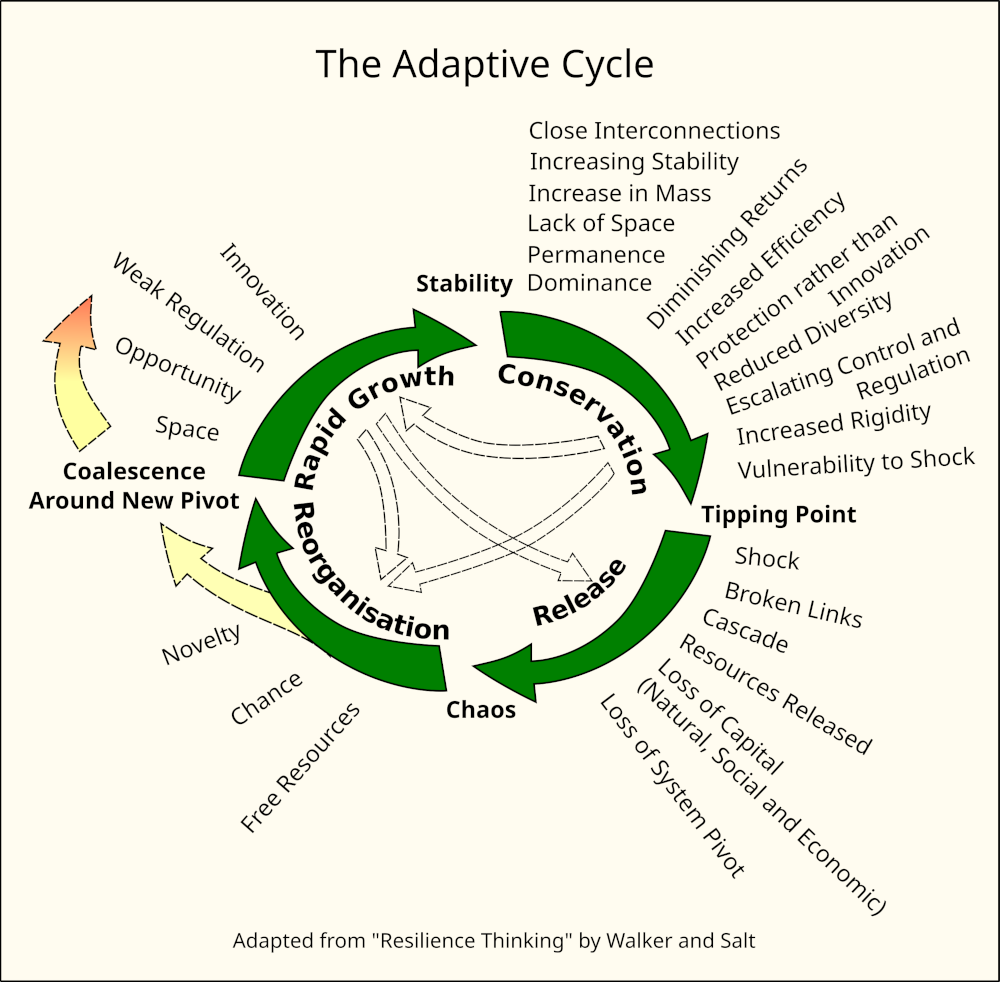
As these become established they will eventually coalesce around a set of organisational principles. If these lie within the bounds that governed the previous cycle the system will return to its previous pattern.
If they are different, the system will begin to move in a new, and unexplored direction leading, potentially, to newly emergent abilities, as indicated by the yellow arrows in the diagram.
The second phase, spurred by the ongoing beneficial balance between the two pressures, is one of exploration, experimentation and population growth.
At its beginning networks are weak and relationships ad hoc. With growing populations, the space for individuality and opportunism will, however, gradually fade.
Then, as time runs its course, symbiotic relationships that harness specialist skills emerge, and organisms draw together for mutual advantage, mutual security and mutual support.
The third phase of conservation, is generally the longest. Within it energy’s exergy is invested heavily in complex, so-called “dissipative”, structures that need large amounts of energy to build and to maintain.
This, with resources now limited, requires greater efficiency. It encourages greater specialisation, collaboration, and complexity, generating intense activity and high levels of productivity.
This is the stage, consequently, when the limits of sustainability are encountered, when self-regulatory processes to constrain productivity evolve, and when a beneficial balance between the two pressures is gradually achieved.
Should such a balance not be achieved, the resources generating productivity will gradually be diminished, links within systems will become stressed, and the stability of the structures be undermined.
Should this continue, the failure of one link within the system will eventually lead to the failure of another and another, producing an escalating cascade of failures. This signifies the fourth phase of release. It results in the collapse of all the structures built within this turn of the cycle.
In the chaos that results a new cycle can, however, begin.
Panarchy
The second system is panarchy. It is both the process and the structure that joins these semi-independent systems and cycles together.
Panarchies are notable for being clumpy, rather than linear. They have many small fast-moving systems at the bottom, and one large slow-moving system at the top. Within the structure, each of the adaptively cycling ecosystems that comprise it, trend towards a discrete size level.6
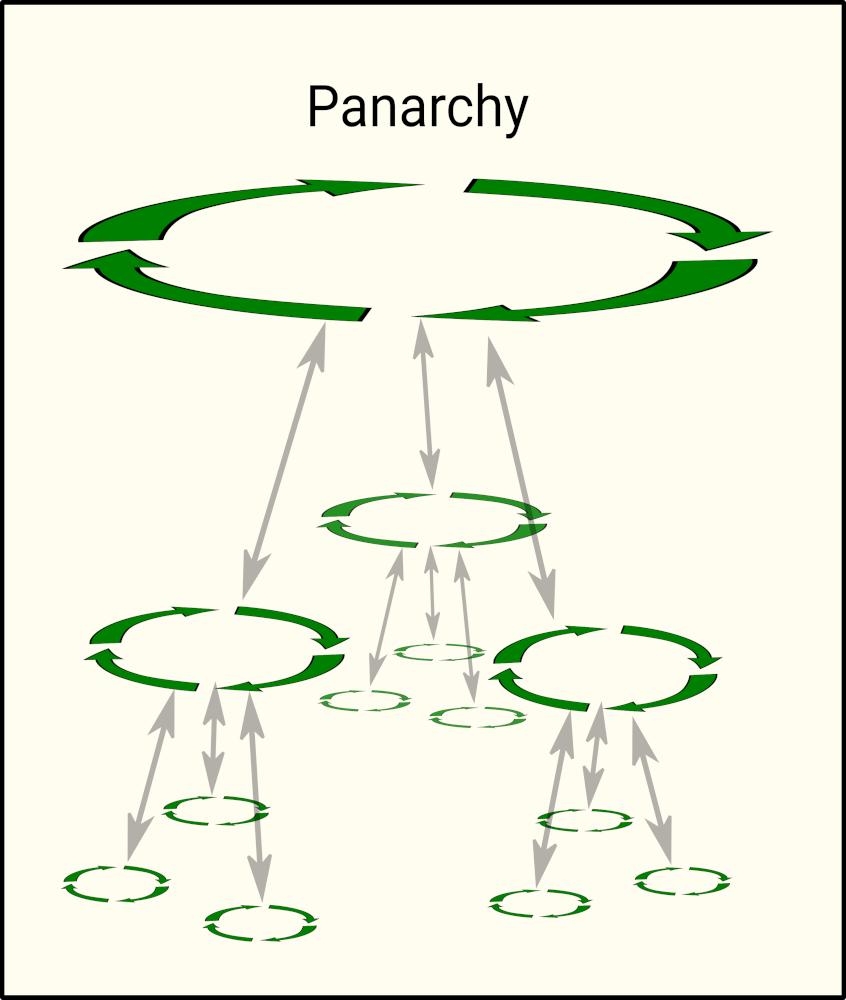
At each of these levels, pressure for change, both up and down the panarchy structure, is triggered by the shock of the release phase at the end of each system’s cycle.
Generally, because each system cycles independently, these pressures occur irregularly and imperceptibly, and change occurs bit by bit.
Should the environment at a particular size level be stressed, however, many systems can reach the release phase of their cycles together. This combined shock can cause massive and sudden change up and down the panarchy structure.
At higher levels of panarchy, regulatory processes to avoid such outcomes have evolved. They include self-imposed population constraint by biological, individual and social means, they include destructive and self-destructive delusional behaviours, they include predation for maintaining the stability of food chains, and they include parasitism, invasive pests, bacterial and fungal infections, viruses, pandemics, genetic disorders, famines, climate change, fire and floods.
In the past the active engagement of these various measures has enabled the conservation phase of the Earth’s biosphere to last for very long periods of time. As regulative measures they have, together, been extremely successful.
Their failure, should this happen, would indicate a failure of the system’s trial and error learning processes, and a need for the entire system to downscale, to regroup and try again.
Life’s Rules
The significance of these processes for us, is that adaptive cycles and panarchy are the self-generating, self-organising, and self-regulating complex systems that have arisen spontaneously, to apply the universal principles of the MSPP to planet Earth.
It will, consequently, be the rules established by their structures and their systems, with which we, as part of nature, will need to comply, if we are to live productively within the universe’s rules. Not living within them, it can be anticipated, will have seriously unwelcome outcomes.
So what are the rules inherent within them? There are, I suggest, four.
One is the need for the pressures pulling together, to persistently exceed those pulling apart. This is necessary to drive productivity growth.
It remains true, however, even when maximum sustainable productivity is reached. Should pressures pulling apart begin, at this point, to dominate, everything, ultimately, would fall apart. Similarly, should the weightings between the two pressures be equally balanced, life would be a lottery.
Life’s persistence over four billion years refutes this. It tells us that the weightings favouring pressures pulling together have been, and need to be, sustained.
Two further rules are prompted by the locus for maximising productivity being set at the level of whole systems. This was seen, in the last chapter, to be a core principle of the MSPP. Here, it is evident in the application of adaptive cycles to whole ecosystems.
One outcome is the building of co-dependence. As seen above, this leads to organisms and species specialising in order to collaborate with others in their communal quest for greater productivity. In human terms it equates with cooperating for the benefit of their joint endeavour.
“Co-working”, however, is not without cost. A major reason is that, to remain sustainable, productivity needs also to be constrained.
This leads to a range of behavioural traits that extend from benevolence, to altruism, to self-denial and to self-sacrifice, with each of these limiting individual productivity, sometimes severely, for the greater good.
The so-called Cambrian explosion some five hundred million years ago was, perhaps, the most extraordinary manifestation of this effect. This was the time when food chains able to transfer energy between species became effective.7
They provided a flow of resources for increasing complexity and for expanding numbers of species, enabling the combined productivity of life to massively increase, driven by, but also constrained by, the predator-prey relationships at each trophic level. This observation suggests a need for altruism extending to self-sacrifice, for the ecosystem’s good.
A situation of a different sort occurs when collaboration and self-restraint are insufficient. When this occurs systems need to down-size rapidly to vent excess capacity, and avoid the onset of release. The effect of parasites and pandemics etc. serve this function.
In summary, the constitutive rules for maintaining maximum sustainable productivity by life’s complex adaptive systems, are:
- the need to maintain a beneficial balance in which pressures pulling together persistently outweigh those pulling apart,
- the need for collaboration extending to cooperation for the common good
- the need for self-restraint, extending to self-sacrifice and altruism for the common good
- and the need to vent unsustainable excesses
These are the ingredients of long-term sustainable communal working that have enabled life and its high productivity, to survive and thrive over four billion years. As the effective the rules of “nature’s morality”, they are the foundation on which the values of our human common morality seen in chapter 2, could later be built.
In the next chapter, in seeking gain insight from history, we explore how these rules influenced life’s evolution across deep time.
Comments
Open, critical, constructive discussion. Please be courteous and patient — Geoff reads when he can.