

9. Paranoia’s Progression
Introduction
The last chapter placed responsibility for the mess our world is in, not with the individuals holding power in it, but with the out-of-balance culture that they, and we, have inherited, and with which both we, and they, comply. This is not to suggest that they, as minions of this culture, have not made it worse.
My life has witnessed the creation of many existential threats, nuclear weapons, global heating, ecological collapse, synthetic biology, space-based warfare, lethal autonomous weapons, global pollution, artificial intelligence, and many more. They are these people’s creations. And yet, if they, genuinely, wish to do good, why would they do this?
Paranoia
This question brings me to one further very powerful delusion, paranoia.
In the last chapter, addiction to the thrills of power, legitimated by the reason/complexity fallacy [Back link] and feeding status [Back link], was seen to be strongly boosted by surging levels of testosterone in the bloodstream.
This gave rise to the so-called “winner effect” and to the many symptoms of testosterone-fuelled power addiction. These processes, it was seen, mirrored those of cocaine addiction.
Paranoia is a recognised symptom of the latter but is rarely linked to winner effect.1 There is, at the same time, sustained medical evidence that regular or high level use of anabolic steroids, causes paranoia,2,3 indicating a likely role for them in the addictive cycle of power.
That cycle can be conceived as:
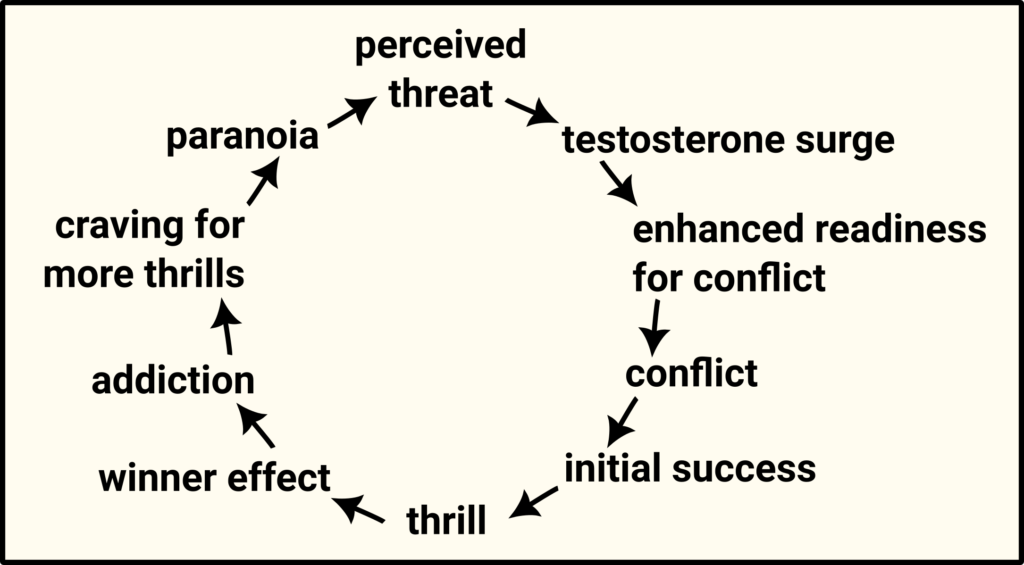
Driven both by the urge for thrill, but also by paranoid fear, this cycle will progressively heighten paranoia, conflict, thrill and addiction, and hasten progress towards megalomania.
This, it appears, is what happens in wars. It also seems to describe relationships on an international scale during my life.
The United States provides good illustration. As Noam Chompsky put it in 2005:
“The United States is a frightened country. And the reasons for this – frankly, I don’t understand them – probably go way back in American history”.4
Here I go back to World War II.
Nuclear Paranoia
The second World War caused the conversion of a previously cooperative international research project of atomic scientists, into a huge, high risk, competitive project to create an atomic bomb. It, the Manhattan project, was secret, scientifically and technologically groundbreaking, thrilling and emotionally challenging and intense – ideal for the dynamics of groupthink [Back link].
Despite the appalling consequences, reactions of this group to the detonation of the bombs, included relief, astonishment, awe, horror, exultation and thrill.5
These emotions, particularly thrill, would be strongly reinforced during the numerous “test” explosions at Bikini Atoll, in the years that followed. In one:
“Observers … saw millions of gallons of lagoon water, turned into steam, appear as a giant bubble. When the steam evaporated, they saw that the island of Elugelab, where the bomb had been, had vanished, vaporised also”.6
Perceived by third party observers as ‘swagger and intimidation’ motivated by the desire to ‘blow something up’, the “tests” seem most likely to have been driven by addiction to the need for high power thrill.
A military evaluation of the consequences was subsequently submitted to, and accepted by, President Truman in 1947. Outlining the immense power of atomic bombs and the huge threat they posed, it stated that:
“In the absence of absolute guarantees of abiding peace, the United States has no alternative but to continue the manufacture and stockpiling of weapons of nuclear fission and to carry on continuous research and development for their improvement and improvement in the means of their delivery.
…. Offensive measures will be the only generally effective means of defense, and the United States must be prepared to employ them before a potential enemy can inflict damage upon us”.7
Paranoia, that is, had set in. It, effectively, marked the beginning of the Cold War, two years before the USSR tested its first atomic bomb.
During the Cold War both sides invested huge sums researching, developing and deploying military technologies of ever-increasing sophistication and complexity in pursuit of military advantage. One outcome was the stockpiling of 20,000 nuclear warheads and 4,500 missile launchers, enough to obliterate all life on Earth very many times over.
Describing these development in 1998, nine years after the ending of the Cold War, retired General Lee Butler, who had been responsible for the control and deployment of all U.S. Air Force and Navy nuclear weapons at the end of the Cold War, stated:
“I knew the moment I entered the nuclear arena I had been thrust into a world beset with tidal forces, towering egos, maddening contradictions, alien constructs and insane risks. Its arcane vocabulary and apocalyptic calculus defied comprehension…. It was in every respect a modern day holy war, a cosmic struggle between the forces of light and darkness…. The opposing forces each created vast enterprises, each giving rise to a culture of messianic believers infused with a sense of historic mission and schooled in unshakable articles of faith… They incited primal emotions, spurred zealotry and demagoguery, and set in motion forces of ungovernable scope and power”.8
The words of General Tommy Power, one of Butler’s predecessors, identifies why:
“Restraint! Why are you so concerned with saving their lives? The whole idea is to kill the bastards!… Look. At the end of the [anticipated] war, if there are two Americans and one Russian, we win!”5
This is neither protection, nor defence. It is the simple ego/status need, driven by paranoia, to win.
However the cultural norms that Butler described were not limited to this group of people. As the “McCarthy witch trials” of the early 1950s demonstrated, paranoia at comparable levels also existed in political circles.9
In the 1970s its focus shifted to include the American public. They, swayed by media reports of U.S. atrocities, denunciations of returning veterans, and ingrained political and military dishonesty revealed in the Pentagon Papers, were deemed responsible for the U.S.’s defeat in the Vietnam war.
The resulting “Vietnam syndrome”, referred to disparagingly by U.S. politicians, hindered their warfaring ambitions for twenty or more years. This appears to be an explanation for the term nontraditional adversaries who engage in nontraditional conflict, that appears in later military reports.10
The culture underlying the paranoia did, however, spread. From the late 1970’s onward the assumptions of the Cold War doctrine of MAD – mutually assured destruction – were adopted, by neoliberal economists, as a foundation for stability within economic markets. They, subsequently, would affect the understandings and attitudes of ordinary people world-wide.11
Paranoia in the Lull
Consequently, despite the ending for the Cold War in 1989, the paranoia continued. As Butler observed in 1998:
“…..the Cold War lives on in the minds of those who cannot let go the fears, the beliefs, and the enmities born of the nuclear age… They are gripped still by its awful willingness not simply to tempt the apocalypse but to prepare its way”8
Two other observation from commentators of this era are worth mentioning. First, in 1992, foreign correspondent H.D.S. Greenway observed:
“Sometimes it seems, with the Cold War over, that we are living in ….. a “threat vacuum”. We seem to be fishing around for something to fill the void……”12
And, in 1996, Samuel Huntington, director of Harvard’s Institute of Strategic Studies, wrote:
‘There can be no true friends without true enemies. Unless we hate what we are not, we cannot love what we are’.13
AI Paranoia
These attitudes set the tone for what followed. The direction came, however, straight out of the military’s report to President Trueman of 1947. It identified a need for:
“…an intelligence service with a far greater effectiveness than any such service this country has had in peace or war”.7
This was the beginning of the search for what is now known as artificial intelligence (AI). Beginning slowly, but accelerating gradually to its present breakneck speed, it, with China as the primary perceived threat, is coming now to a head.
Official U.S. reports illustrate both threats, and resulting fears. For instance, in 2019, a report, primarily, of AI entrepreneurs stated:
“For the first time since World War II, America’s technological predominance—the backbone of its economic and military power—is under threat. China possesses the might, talent, and ambition to surpass the United States as the world’s leader in AI in the next decade”
“Human operators will not be able to keep up with or defend against AI-enabled cyber or disinformation attacks, drone swarms, or missile attacks without the assistance of AI-enabled machines.”
“China is organized, resourced, and determined to win this contest.”14
The 2024 U.S.-China Economic and Security Review Commission recommended:
“Congress establish and fund a Manhattan Project-like program dedicated to racing to and acquiring an Artificial General Intelligence (AGI) capability…. with the goal of U.S. AGI leadership.”15
The 2025 U.S.-China Economic and Security Review Commission observed:
“Beijing has continued to rapidly modernize its military forces across all domains with the goal of being able to fight and defeat “strong enemies” like the United States.”16
Underlying these official documents one can be forgiven for hearing the echo of General Lee Butler’s words above.
And so in 2025 the U.S. administration duly launched its version of the AI Manhattan project termed the Genesis Mission.17
Paranoia’s Legacy
These developments focus almost exclusively on the United States. As the previously dominant, but challenged, economic and military global super-power, there is good reason for it to feel threatened.
That said, there seems little doubt that the same dynamics, driven by both thrill and threat, are being felt by all those involved in the AI race for dominance and/or survival. These dynamics, that is, seem to have taken over our world.
However, as noted in chapter 1 [Back link], in a world of opportunities and threats, if all we ever ever see are the threats (that trigger testosterone surges [Back link] and prepare us for conflict) the world can and will, only get worse, not better. This is the cycle we are in.
In the next chapter we will see how much worse this could very soon get.